
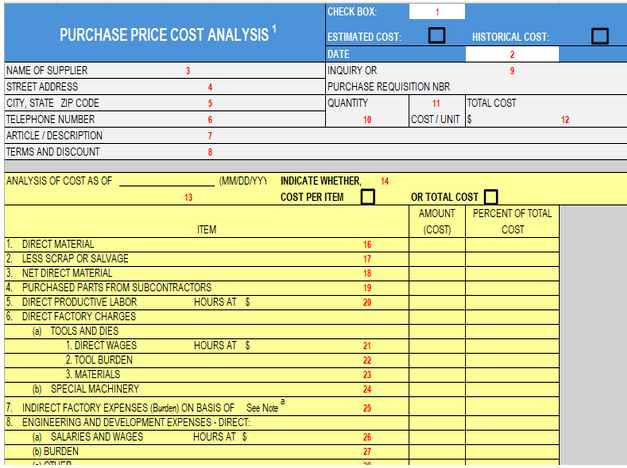
Purchase Price Cost Analysis
$299.95
Purchase Price Cost Analysis for Buyers | Break Down Supplier Quotes
Ambiguous, “all-in” supplier quotations are one of the quiet killers of margin in procurement. A Buyer receives a quote—one total number, maybe a short description, and little else. Whether it’s a high-dollar commodity buy or a complex piece of capital equipment, the same problem shows up: no visibility into what is really driving the cost. Without that visibility, procurement is left guessing, negotiating in the dark, and often overpaying without realizing it.
This is exactly where Purchase Price Cost Analysis earns its place as a core discipline in professional procurement.
When suppliers submit bundled pricing, they are combining multiple cost elements into a single figure—raw materials, labor, overhead, profit, logistics, risk buffers, and sometimes inefficiencies. For the Buyer, that creates a blind spot. You can’t validate what you can’t see. And if you can’t validate it, you certainly can’t challenge it.
A structured Purchase Price Cost Analysis removes that blind spot by breaking the quoted price into its individual components. It introduces transparency into the supplier’s pricing model and allows procurement to move from assumption-based decisions to fact-based evaluation. This is particularly valuable when applying should cost analysis in procurement, where the objective is to align supplier pricing with realistic cost drivers rather than accepting a packaged number at face value.
Consider a company’s capital equipment purchase. A supplier may present a $500,000 quote with minimal detail. On the surface, it may appear competitive. But what’s inside that number? Is the engineering time overstated? Are material inputs aligned with current market rates? Is there excessive contingency built into the price? Without a structured cost breakdown analysis, those questions remain unanswered.
By implementing a disciplined approach, the Buyer gains access to the underlying cost structure. This often includes:
- Direct material inputs and assumptions
- Labor hours and applied rates
- Manufacturing or assembly overhead
- Tooling, setup, or non-recurring engineering (NRE) costs
- Scrap or yield assumptions
- Freight, packaging, and handling
- Supplier margin
This level of detail transforms procurement from reactive purchasing into analytical decision-making.
From there, the Buyer can achieve three critical outcomes.
First, understand the charges.
Clarity is the foundation. A well-designed supplier cost breakdown template forces suppliers to disclose how their price is constructed. This eliminates ambiguity and ensures consistency across all bids. Instead of reviewing a single total price, the Buyer sees each contributing factor and can trace how the number was built. This is especially important in custom manufacturing environments where cost drivers vary significantly from one supplier to another.
Second, determine whether pricing is fair and reasonable.
Once the cost elements are visible, procurement can apply experience, benchmarks, and market intelligence. This is where procurement cost analysis techniques become highly effective. Material costs can be compared against commodity indices. Labor input can be evaluated against known production standards. Overhead and margin can be assessed relative to industry norms.
At this point, the conversation with the supplier changes. Instead of asking for a general price reduction, the Buyer can challenge specific cost drivers. For example: “Your labor hours appear higher than comparable builds—walk me through your assumptions.” That level of specificity creates leverage and drives more meaningful negotiations.
Third, compare supplier quotations accurately.
One of the biggest challenges in sourcing is comparing bids that are structured differently. Without standardization, it’s nearly impossible to conduct a true RFQ cost comparison analysis. One supplier may include tooling in their price, while another separates it. One may assume higher scrap rates, while another assumes optimized production. The total prices may look similar, but the underlying economics—and risks—are not.
A consistent Purchase Price Cost Analysis framework aligns all suppliers to the same format. This enables side-by-side comparison of each cost element, ensuring that decisions are based on true cost competitiveness rather than surface-level pricing. It also helps identify outliers—areas where a supplier may be overestimating or underestimating key inputs.
Beyond individual sourcing events, this approach builds long-term capability within the procurement function. Historical cost data becomes a powerful asset. Over time, Buyers develop internal benchmarks that strengthen future negotiations and improve forecasting accuracy. This naturally supports broader strategies such as total cost of ownership (TCO) analysis, where procurement evaluates not just the purchase price, but the full lifecycle cost of a product or service.
It also reduces downstream risk. Hidden costs in ambiguous quotes often reappear later as change orders, delays, or quality issues. By forcing transparency upfront, procurement minimizes surprises and protects both cost and operational performance.
The reality is simple: when Buyers accept all-in pricing without scrutiny, they give up control. They rely entirely on the supplier’s assumptions, cost structure, and pricing discipline. Sometimes that works out. Often, it doesn’t.
Purchase Price Cost Analysis changes that dynamic.
It gives procurement the tools to break apart complex pricing, understand what they are truly paying for, and validate whether those costs make sense. It enables fair, fact-based negotiations and creates a level playing field for supplier comparison.
In an environment where even a small percentage of cost variance can significantly impact profitability, that level of insight is not optional, it’s essential.
You can find out more about the Purchase Price Cost Analysis by following one of the links below.
https://GetYourPurchasingDocuments.com/products/Purchase-Price-Cost-Analysis/
https://preferredcfo.com/insights/cost-analysis-and-price-analysis/
I work with companies to reduce material and supplier costs, improve EBIT and working capital, strengthen supplier accountability, and bring order to the full procure-to-pay process, so procurement becomes a source of value, not chaos.
Let’s talk: 469-500-3040
Products Include:
The price includes links to everything you need to use the form(s). The forms, explanation, examples, and the link download(s) are located in your account under Digital Forms.
Purchase Price Cost Analysis
Purchase now and get immediate access the file
$299.95


