
Request for Quotation (RFQ) Template
$99.95
Request for Quotation (RFQ) Form | Competitive Procurement Tool
In disciplined procurement organizations, a Request for Quotation is not a courtesy email asking suppliers to “send pricing.” It is a control mechanism. When designed correctly, it forces comparability, constrains supplier assumptions, and shifts leverage decisively back to the buyer. When designed poorly, it produces fuzzy quotes, hidden costs, endless clarifications, and negotiations that feel more like archaeology than sourcing.
That difference is not academic. It shows up in margin, cycle time, audit exposure, and supplier behavior.
At this point in the procurement process, buyers should be at that juncture where they are going to send a Request for Quotation (RFQ) to suppliers. These suppliers should already have completed a Non-Disclosure Agreement (NDA) and are either an approved supplier or a supplier that is in the final stages of the approval process. If you need an example of a non-disclosure agreement, you can find an example of a Non-Disclosure Agreement (NDA) by following the link below.
https://getyourpurchasingdocuments.com/product/non-disclosure-agreement/
Likewise, if you are beginning work on approving a new supplier, you can find an example of a Supplier Self-Self-Assessment Survey or a Supplier Operations Audit by clicking on the links below.
https://getyourpurchasingdocuments.com/product/supplier-self-assessment-survey/
https://getyourpurchasingdocuments.com/product/supplier-operations-audit/
At its core, a Request for Quotation is a structured, written demand for pricing and commercial terms under defined conditions. It converts vague purchasing intent into a standardized pricing request that suppliers must respond to on the buyer’s terms, not their own. This is why mature procurement teams treat the RFQ as a governance document, not just a step in the sourcing workflow.
The Request for Quotation (RFQ) Form Forces Comparability Not Guesswork
The primary job of a Request for Quotation is to enable ‘apples-to-apples’ quote comparison. Without tight structure, suppliers’ price different assumptions: different volumes, different delivery terms, different lead times, and different cost inclusions. The result looks competitive on the surface but collapses under scrutiny.
A properly executed RFQ procurement process eliminates that ambiguity by defining commercial and technical specifications in advance. Quantities, tolerances, packaging, quality standards, and delivery expectations are stated explicitly. Suppliers are not invited to “interpret.” They are instructed to comply.
This is where issuing an RFQ to suppliers becomes an act of control rather than administration. By requiring supplier cost breakdown requirements—material, labor, overhead, tooling, logistics, and margin, the buyer exposes cost drivers that would otherwise remain buried inside a lump-sum price. Tooling and non-recurring costs are separated. Logistics and freight assumptions are surfaced instead of hidden. Minimum order quantities (MOQ) are declared rather than discovered later.
That structure makes supplier pricing comparison real, not rhetorical.
The Request for Quotation (RFQ) Form Shifts Leverage Back to the Buyer
Suppliers naturally prefer ambiguity. Ambiguity gives them room to adjust later. A disciplined request for quotation document removes that room.
By defining lead time and delivery commitments, the buyer prevents post-award renegotiation disguised as “capacity constraints.” By requiring a quote validity period, the buyer prevents suppliers from shortening pricing windows to force rushed decisions. By demanding explicit supplier assumptions and exclusions, the buyer converts future disputes into present-day clarifications.
This is why the sourcing RFQ process compresses negotiation cycles when executed correctly. Most negotiation pain comes from discovering misalignment late. A well-designed RFQ front-loads that ‘discovery,’ and reduces clarification rounds with suppliers after pricing is received.
Instead of debating what the supplier “meant,” procurement evaluates what the supplier committed to in writing.
The Request for Quotation (RFQ) Form – from Quotes to Defensible Decisions
An ‘RFQ’ is only as strong as its evaluation discipline. Structured responses enable the use of an RFQ response evaluation matrix that scores suppliers across price, lead time, commercial terms, risk, and compliance. This transforms sourcing from opinion-based selection into documented decision-making.
That documentation matters. Documented supplier quotes tied to a defined procurement RFQ form create an audit trail that survives executive review, internal audits, and external scrutiny. When sourcing decisions are challenged, the buyer can point to a controlled competitive bidding process rather than individual judgment.
This is where procurement infrastructure shows its value. A casual supplier quotation request produces emails. A controlled RFQ produces records.
Request for Quotation (RFQ) Form – Eliminating Fuzzy Quotes and Hidden Costs
Most hidden costs are not hidden at all—they are simply not asked about. A structured RFQ template procurement forces suppliers to disclose elements they would prefer to gloss over: expediting fees, packaging premiums, payment terms dependencies, or pricing tied to unrealistic volumes.
When suppliers are required to respond within a standardized format, ambiguity collapses. When pricing is submitted against the same commercial baseline, negotiation becomes surgical rather than adversarial.
The result is not just better pricing. It is better predictability.
Request for Quotation (RFQ) Form – Part of the Procurement System
A Request for Quotation does not live in isolation. Instead, it sits between supplier qualification and purchase order issuance, feeding downstream controls. RFQ outputs inform supplier selection, pricing approvals, and ultimately the terms embedded in the purchase order.
On GetYourPurchasingDocuments.com, RFQ tools are designed to integrate cleanly with upstream supplier evaluation documents and downstream Purchase Order Terms and Conditions. On mscsgrp.com, the RFQ framework is positioned as part of a broader procure-to-pay control model, reinforcing that sourcing discipline does not stop at price selection.
This linkage is what separates downloadable paperwork from procurement infrastructure.
The Strategic Payoff
A properly designed RFQ eliminates fuzzy quotes, exposes hidden costs, compresses negotiation cycles, and creates documentation that holds up under pressure. It changes supplier behavior by removing ambiguity. It changes buyer behavior by enforcing structure. And it changes outcomes by replacing negotiation theater with disciplined comparison.
In procurement, leverage is rarely about volume alone. It is about who controls the rules of engagement. A strong Request for Quotation does exactly that—and does it in writing.
If you would like to have a copy of a Request for Quotation (RFQ) Form that includes a quote form summary tab, you can find it by clicking the link below.
https://getyourpurchasingdocuments.com/product/request-for-quotation-rfq/
If you would like to learn more about the Request for Quotation (RFQ) Form, just follow one of the links below.
https://quollnet.com/article/request-for-quotation-rfq-form-template
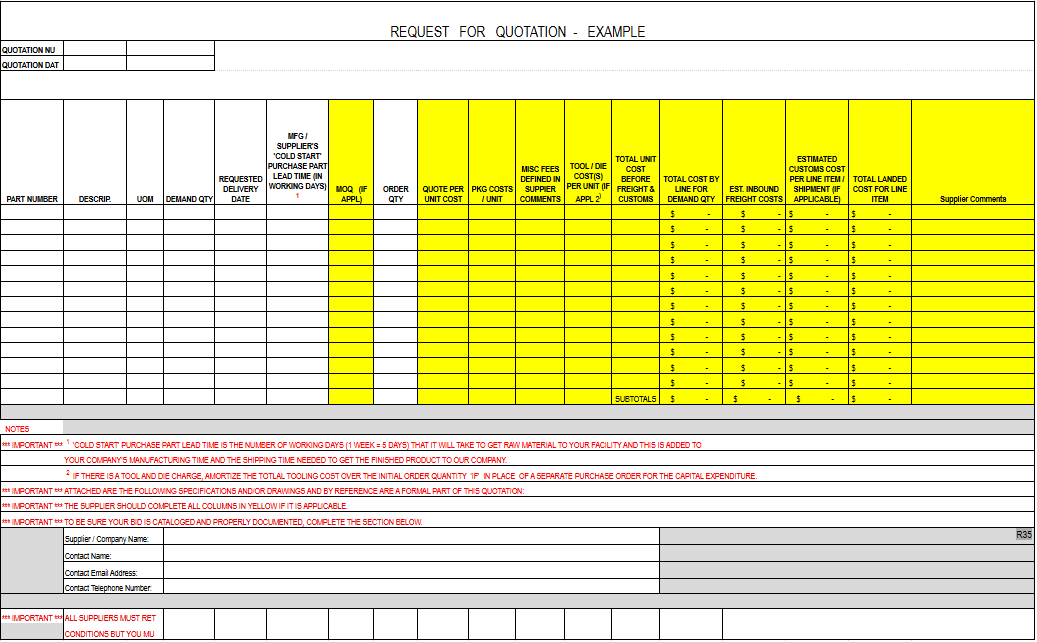
Products Include:
The price includes links to everything you need to use the form(s). The forms, explanation, examples, and the link download(s) are located in your account under Digital Forms.
Request for Quotation (RFQ) Template
Purchase now and get immediate access the file
$99.95


