Newsletter
Sign up to stay informed on the latest news and exclusive offers from Get Your Docs.


$199.95
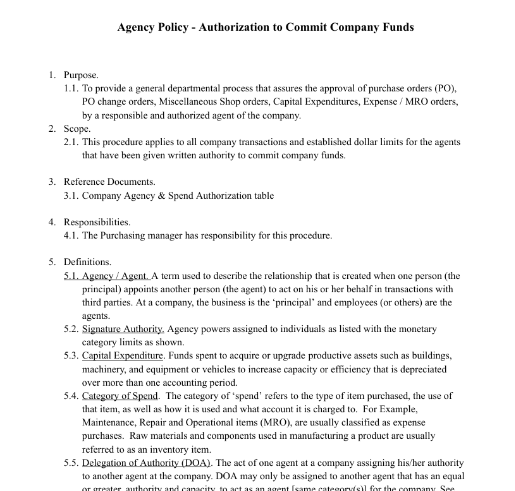
An agency policy in business defines who has the authority to act on behalf of a company—whether that means signing contracts, approving purchases, or committing company funds. At its core, this corporate agency policy establishes clear boundaries around agency authority in business, ensuring that only designated individuals can make binding decisions. Without it, organizations expose themselves to unnecessary risk, including unauthorized agreements, financial leakage, and legal disputes.
From a practical standpoint, an effective agency policy is tightly aligned with a company’s delegation of authority policy and financial authority matrix. It clarifies employee authority levels, outlines authorized signatory policy requirements, and supports strong corporate governance policy standards. This becomes especially critical in procurement, where purchasing approval limits and a defined procurement authorization policy prevent unauthorized spending and enforce discipline across the procure-to-pay approval workflow.
As companies grow, the importance of structured authority increases. A well-defined spending authority policy enables scalability by allowing leaders to delegate decision-making without losing control. It ensures that contract signing authority and supplier contract authorization are handled appropriately, reducing risk while maintaining operational speed.
Ultimately, an agency policy is not just a legal safeguard—it is a business control mechanism. It protects margins, strengthens accountability, and ensures that every financial commitment aligns with company strategy.

Free
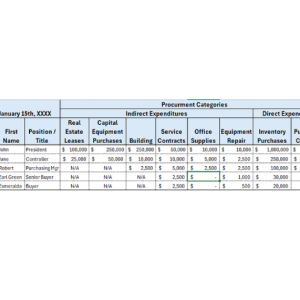
Approval Limits in Purchasing is not a bureaucratic hurdle — it’s a critical safeguard approved by executive management that defines who can commit company funds, at what level, and under what circumstances. And when companies expand, complexity multiplies and without structured controls, purchasing decisions can become a breeding ground for overspending, compliance failures, or even fraud. But an Approval Limits in Purchasing matrix reduces risk, ensures financial discipline, and protects company assets from misuse.
At its core, an Approval Limits in Purchasing Table serves as a company’s internal firewall between legitimate business expenditures and potential financial exposure. It ensures that only authorized individuals with designated budget and role-based authority—can approve expenditures or sign contracts on behalf of the organization. Without this clarity, even well-intentioned employees can unintentionally overcommit funds, violate approval policies, or bypass compliance standards.
At GetYourPurchasingDocuments.com, the ready-to-use Approval Limits template was developed to help manufacturers and procurement professionals quickly install structured financial controls aligned with both corporate governance and procurement best practices. It transforms abstract policy into a working system of checks and balances that’s easy to implement, audit, and maintain.
Approval Limits in Purchasing Reduces Financial Risk
Unclear or inconsistent approval structures can create real damage. In growing organizations, departments often operate semi-independently, and managers may authorize purchases without full visibility of the company’s overall budget or contractual obligations. This fragmentation leads to duplicated orders, maverick spending and weakened financial control.
By contrast, a clearly defined Approval Limits in Purchasing Table provides a transparent roadmap of financial authority. It:
When properly implemented, approval limits don’t just restrict authority; they empower teams to operate confidently, within defined parameters and with higher efficiency. Managers know their limits, finance can forecast budgets accurately, and executives can focus on strategic initiatives instead of chasing down unauthorized purchases.
Approval Limits in Purchasing Strengthen Procurement Governance
An Approval Limits in PPurchasing Table is not a standalone document—it’s the backbone of a company’s Procurement Governance Framework. When linked with other essential tools such as a Purchase Requisition Form, Request for Quotation (RFQ), and Purchase Order Terms & Conditions, the approval structure becomes embedded within the company’s daily operations.
By integrating approval limits into procurement workflows, companies can:
This connection between documents creates a closed-loop system where every purchase—from request to payment—is validated against the organization’s financial authority map. It’s a governance model that not only reduces risk but also builds confidence with auditors, investors, and customers who value financial integrity.
Approval Limits in Purchasing Table and How It Provides Benefits
Executive Management and Procurement team members use it to enforce spending discipline and ensure purchasing aligns with policy.
Finance Teams depend on it to verify that each purchase matches an approved budget.
Executives rely on it to delegate authority efficiently without losing oversight.
Auditors and Compliance Officers reference it to confirm accountability and trace financial decisions.
Each of these roles contributes to the integrity of the organization’s financial ecosystem, and the Approval Limits Table is the common language that connects them all.
What’s Included in the Approval Limits in Purchasing Template
The downloadable Approval Limits in Purchasing Template from GetYourPurchasingDocuments.com includes:
To implement effectively:
You can see an example of a complete Purchase Requisition form by clicking on the link below:
https://getyourpurchasingdocuments.com/product/complete-purchase-requisition-form/
In less than a day, your organization can have a documented, auditable financial approval process that meets the standards of governance, risk management, and compliance.
Why Approval Limits in Purchasing Protect Company Assets
Installing Approval Limits in Purchasing is more than policy—it’s protection. It shields your company’s assets, enforces accountability, and ensures every dollar spent contributes directly to business objectives. In short, it’s how responsible organizations stay in control while empowering their teams to act decisively and transparently.
Download the Approval Limits in Purchasing Template today and give your company the structure it needs to grow safely, efficiently, and profitably.
https://getyourpurchasingdocuments.com/product/approval-limits-in-purchasing/
Learn more about Purchase Order Approval and the associated Approval Limits in Purchasing by visiting,
https://www.inflowinventory.com/blog/why-your-business-needs-a-purchase-approval-process/

$299.95
Procurement Time Study Analysis: Turning Purchasing Activity into ‘Value Add’ Using Measurable Control
Procurement teams are often described as “busy,” but busy is not a metric. Without hard data, leaders are left guessing whether delays, cost overruns, and backlogs are caused by staffing gaps, broken processes, or uncontrolled demand. A Procurement Time Study Analysis replaces assumptions with evidence by measuring how purchasing work actually ‘flows’ through the organization.
At its core, this analysis breaks procurement activity into discrete tasks, measures the time required to complete them, and ties that effort back to volume, complexity, and cost. The result is a fact-based view of purchasing performance that supports better decisions around headcount, workflow design, automation, and internal controls.
What a Procurement Time Study Analysis Actually Measures
A well-structured time study is not about micromanaging buyers. It is about understanding the mechanics of the procurement function. Activities are typically grouped across the procure-to-pay process, including requisition review, supplier sourcing, quote evaluation, purchase order creation, supplier communication, change management, receiving coordination, and invoice resolution.
Follow the link below to learn more about the Procure-to-Pay (P2P) Process
By separating ‘touch time vs wait time,’ the analysis reveals where value is created and where ‘work simply stalls.’ This distinction is critical. Long cycle times are rarely caused by buyers working too slowly. They are more often the result of unclear approval workflows, incomplete purchase requisitions, poor supplier responsiveness, or manual rework that should never have existed.
This is where purchasing process analysis becomes practical rather than theoretical. When time is measured by activity instead of job title, inefficiencies surface quickly and defensibly.
Why a Procurement Time Study Analysis Matters for Procurement Cost and Capacity
Procurement labor is an indirect cost, which means it is often poorly understood and rarely optimized. A time study makes that cost visible. When effort is tied to transaction volume, organizations can calculate cost per purchase order, evaluate workload balancing, and perform meaningful buyer capacity planning.
This level of insight is essential when leadership asks whether more staff are required or whether existing resources are being consumed by non-value-added work. A procurement productivity analysis grounded in real data prevents over-hiring while also protecting teams from unrealistic workload expectations.
It also supports purchasing efficiency analysis by showing ‘how and where’ automation, standardization, or policy changes will deliver the greatest return.
Using a Procurement Time Study Analysis to Identify Bottlenecks Across the Procure-to-Pay Process
One of the most valuable outcomes of a ‘time study’ is bottleneck identification. Procurement workflow analysis often reveals that delays occur upstream or downstream of the buyer, not at the buyer’s desk. Common culprits include poorly defined approval authority, inconsistent use of standardized forms, and suppliers receiving incomplete information.
For example, excessive time spent clarifying requirements can often be traced back to weak Purchase Requisition discipline. Likewise, frequent purchase order revisions usually point to missing approval limits or uncontrolled change management.
When paired with standardized documents such as a Purchase Requisition Form, Approval Limits in Purchasing, and a Purchase Order form, time study data becomes actionable instead of academic.
You can see a good example of a complete Purchase Requisition form, Approval Limits in Purchasing table, and Purchase Order form by using the links below.
https://getyourpurchasingdocuments.com/product/purchase-requisition-form/
https://getyourpurchasingdocuments.com/approval-limits-in-purchasing/
https://getyourpurchasingdocuments.com/product/purchase-order-form/
Using Procurement Time Study Analysis Data to Drive Drastic Process Improvements
Time study results are most powerful when used to redesign work, not simply report on it. By categorizing activities as value-added vs non-value-added, organizations can eliminate redundant steps, reduce manual handoffs, and simplify approval workflows.
This is where ‘cycle time’ by procurement activity becomes a management tool. Leaders can see which tasks should be automated, which require clearer work instructions, and which are better handled earlier in the process. The analysis also supports lean procurement analysis by highlighting waste that would otherwise remain invisible.
When improvements are implemented, the ‘time study’ provides a baseline for measuring gains, ensuring that process changes deliver results.
A Procurement Time Study Analysis Supports Audits, Compliance, and Scalability
Beyond efficiency, a Procurement Time Study Analysis strengthens governance. When activities are standardized and measured, it becomes easier to demonstrate internal controls in procurement and maintain a defensible audit trail for purchasing activities.
This matters not only for audits but for growth. As organizations scale, informal processes collapse under volume. Time studies reveal whether procurement operations are scalable or overly dependent on tribal knowledge. They also support ERP readiness assessment by identifying where manual workarounds are compensating for system gaps.
Used correctly, the analysis becomes a foundation for continuous improvement procurement initiatives rather than a one-time exercise.
When a Procurement Time Study Analysis Should Be Used
A ‘time study’ is especially valuable when procurement teams are experiencing rising backlog, increasing cycle times, or pressure to justify headcount. It is also effective during process redesign efforts, system implementations, or post-merger integration when workflows are inconsistent.
However, it should not be used as a blunt performance tool. The goal is transparency, not surveillance. When positioned correctly, it equips procurement leaders with the data needed to protect their teams while improving outcomes.
A Procurement Time Studay Analysis is a Diagnostic Tool, not a Spreadsheet
The Procurement Time Study Analysis tool available on GetYourPurchasingDocuments.com is designed to be practical, structured, and repeatable. It aligns naturally with other core procurement controls, including the Procure-to-Pay framework, standardized purchasing forms, and supplier performance management tools.
Used together with documents such as the Purchase Requisition, Purchase Order, Purchasing Record, and Supplier Performance Scorecard, it helps organizations move from reactive purchasing to disciplined, measurable procurement operations.
In short, this tool turns “busy” into data, and data into decisions.
You can find a Procurement Time Study tool by clicking on the link below.
https://getyourpurchasingdocuments.com/procurement-time-study-analysis/
If you would like to read more about ‘How to Improve Purchase Order Cycle Time,’ you can learn more by following the link below.
https://www.procurify.com/blog/improve-purchase-order-cycle-time/
Monday – Friday: 9:00 AM – 5:00 PM CST
Other Dates and Times: By Appointment Only
469.500.3040
4705 Melrose Park Ct
Colleyville, Texas 76034
New Documents Coming Soon:
Site by DFW Website Designers
Sign up to stay informed on the latest news and exclusive offers from Get Your Docs.