Newsletter
Sign up to stay informed on the latest news and exclusive offers from Get Your Docs.


$299.95
Non-Disclosure Agreement: The First Line of Defense in Procurement and Supplier Engagement
A Non-Disclosure Agreement is one of the most fundamental yet frequently delayed documents in procurement and supplier management. It exists for a simple reason: once sensitive information leaves your organization, control is gone unless legal boundaries are already in place. In modern supply chains—where suppliers, vendors, contract manufacturers, and service providers routinely require access to pricing, designs, forecasts, and operational data—the absence of a formal agreement is not an oversight. It is a risk exposure.
A well-structured Non-Disclosure Agreement establishes disclosure restrictions, defines ownership of information, and creates legal enforceability before any meaningful business conversation begins.
Why a Non-Disclosure Agreement Must Come Before Supplier Discussions
Procurement teams routinely share more than they realize. Requests for quotation, engineering drawings, specifications, cost breakdowns, volume forecasts, and customer requirements are all forms of confidential information. Without a signed Non-Disclosure Agreement, there is no contractual obligation preventing a third party from misusing that data.
This is why best-in-class organizations require an NDA before RFQ and certainly an NDA before supplier engagement. Once information is shared, legal remedies become difficult, expensive, and uncertain. Preventive controls always outperform reactive damage control.
This is especially critical when onboarding new suppliers through a formal Supplier Onboarding Process or initiating competitive sourcing events using a standardized Request for Quotation (RFQ).
You can see an example of an RFQ, with a bid summary page, by accessing the link below.
https://getyourpurchasingdocuments.com/product/request-for-quotation-rfq/
A Non-Disclosure Agreement vs. Confidentiality Agreement: No Practical Difference, Big Practical Impact
In practice, a Non-Disclosure Agreement and a confidentiality agreement serve the same function. Both govern how information may be used, disclosed, and protected. The distinction is largely semantic. What matters is clarity.
A professionally drafted non-disclosure agreement template eliminates ambiguity by clearly defining:
Templates that lack these elements create false confidence and weak contract compliance.
Choosing the Right Non-Disclosure Agreement Structure
Unilateral Non-Disclosure Agreement in Procurement
A unilateral non-disclosure agreement is the most common structure used in procurement. Information flows in one direction—from the buyer to the supplier. This is appropriate when sharing proprietary pricing models, internal cost data, forecasts, or intellectual property tied to manufacturing or sourcing strategies.
This structure is ideal for:
Mutual Non-Disclosure Agreement for Strategic Relationships
A mutual non-disclosure agreement is used when both parties expect to exchange sensitive information. This is common in joint development, contract manufacturing, or strategic partnerships. While mutual agreements appear balanced, they still require careful review to ensure disclosure restrictions and liability terms are symmetrical and enforceable.
Both structures should be governed by a standardized NDA form approved by legal and procurement leadership.
Non-Disclosure Agreement as a Procurement Risk Control
A procurement non-disclosure agreement is not merely a legal form; it is a risk mitigation mechanism embedded within the procure-to-pay process. It supports:
Organizations that formalize NDAs as part of their Supplier Risk Assessment and contracting workflows dramatically reduce the likelihood of data leakage and supplier disputes.
Legal Enforceability and What Makes an NDA Hold Up
Legal enforceability depends on clarity, jurisdiction, and reasonableness. An effective business non-disclosure agreement avoids vague definitions, excessive timeframes, and unrealistic restrictions. Courts are more likely to enforce agreements that clearly balance protection with commercial practicality.
Equally important is documentation discipline. NDAs must be executed, tracked, and referenced in downstream contracts such as Purchase Order Terms & Conditions to maintain continuity and enforceability.
You can find more information about protecting your company in several areas by following the link below.
https://getyourpurchasingdocuments.com/uncategorized/procurement-document-toolkit/
You can also find an example of Purchase Order Terms and Conditions by clicking on the link below.
https://getyourpurchasingdocuments.com/product/purchase-order-ts-and-cs/
Non-Disclosure Agreement, Operational Discipline: When and How to Use One
A Non-Disclosure Agreement should be mandatory when:
Organizations that rely on informal email disclaimers or verbal assurances are gambling with their most valuable assets.
Embedding NDAs into approval workflows, authority matrices, and supplier onboarding checklists strengthens contract compliance and reinforces accountability across procurement, engineering, and operations.
Not Having a Non-Disclosure Agreement: The Cost of Getting It Wrong
A breach of confidentiality is rarely accidental from a legal standpoint. If no agreement exists, the burden shifts entirely to the company that disclosed the information. Litigation becomes harder, leverage disappears, and competitive advantage erodes quietly.
Some manufacturers mistakenly assume an NDA is optional. Until it isn’t. Without an executed confidentiality agreement, companies are exposed to:
In contrast, a properly executed Non-Disclosure Agreement creates a clear standard of conduct and a defensible response when violations occur.
A Non-Disclosure Agreement is a Standard Requirement of a World-Class Purchasing Process
World-class procurement teams don’t treat NDAs as optional paperwork. They bake confidentiality agreements into their sourcing workflow:
This sequence protects the company, speeds up the quoting cycle, and gives suppliers confidence that the information they share is equally protected.
When every supplier follows the same process, conflict drops, compliance increases, and commercial discussions flow cleanly.
Final Thought: Control the Door Before Opening It
A Non-Disclosure Agreement is not a blocker to doing business. It is the doorframe that keeps the structure intact. When procurement teams treat NDAs as a required first step—alongside RFQs, supplier onboarding, and approval limits and a purchase order form—they replace risk with control and assumptions with enforceable obligations.
One final note. Because of the serious nature of this contractual obligation, some companies require an officer from each company to complete the supplier Confidentiality agreement.
Protect your company with Non-Disclosure Agreements today. You can find examples of NDAs by visiting Get Your Purchasing Documents, LLC today https://getyourpurchasingdocuments.com/.
That discipline scales. Chaos does not.
If you would like to learn more about Non-Disclosure Agreements, you can also click on the link below:

$299.95
NON-DISCLOSURE AGREEMENT FOR SUPPLIERS: PROTECTING INTELLECTUAL PROPERTY BEFORE RFQ AND ENGAGEMENT
Modern procurement runs on information. Pricing models, cost breakdowns, forecasts, engineering drawings, production volumes, customer data, and sourcing strategy documents move across organizational boundaries daily. The moment that information leaves your system, your protection depends entirely on one document: the Non-Disclosure Agreement.
A properly structured Non-Disclosure Agreement is not paperwork. It is a governance control. It defines ownership, limits use, establishes remedies, and reduces commercial exposure before supplier engagement begins. Without it, procurement teams expose intellectual property, trade secrets, and financial data without enforceable boundaries.
In high-performing organizations, the Non-Disclosure Agreement is executed before RFQ release, before supplier onboarding, and certainly before technical data is shared.
This is not legal paranoia. It is operational discipline.
WHAT IS A NON-DISCLOSURE AGREEMENT IN PROCUREMENT?
A Non-Disclosure Agreement (often referred to as an NDA) is a legally binding contract that restricts how confidential information may be used or disclosed. In procurement environments, it protects buyers when sharing sensitive commercial or technical data with suppliers, vendors, and contract manufacturers.
The agreement typically defines:
When embedded into the procurement workflow, the Non-Disclosure Agreement becomes a risk mitigation mechanism within the broader procure-to-pay process.
WHY A NON-DISCLOSURE AGREEMENT MUST PRECEDE RFQ AND SUPPLIER ENGAGEMENT
Procurement teams often underestimate the sensitivity of routine documents. A Request for Quotation (RFQ) can contain:
You can find an example of an RFQ by clicking on the link below.
https://getyourpurchasingdocuments.com/product/request-for-quotation-rfq/
Without a signed Non-Disclosure Agreement, a supplier has no contractual obligation to protect that information.
Best-in-class organizations require an NDA before RFQ issuance and certainly before formal supplier engagement. This ensures enforceability of contracts signed by agents and limits downstream exposure.
For example, your standardized Request for Quotation (RFQ) template should never be distributed until the NDA execution step is completed and logged within your procurement approval workflow.
Preventive governance always outperforms reactive litigation.
NON-DISCLOSURE AGREEMENT VS CONFIDENTIALITY AGREEMENT
In practical business application, a Non-Disclosure Agreement and a confidentiality agreement serve the same purpose. The difference is semantic, not functional.
What matters is clarity of terms, scope of restrictions, and enforceability.
A professionally drafted non-disclosure agreement template eliminates ambiguity by clearly defining:
Templates lacking these elements create weak contract compliance and false security.
UNILATERAL VS MUTUAL NON-DISCLOSURE AGREEMENT STRUCTURES
Unilateral Non-Disclosure Agreement
A unilateral Non-Disclosure Agreement protects one disclosing party. This is the most common structure in procurement when the buyer shares sensitive data with suppliers.
Typical use cases:
In sourcing environments, information flow is often one-directional. A unilateral structure reflects that reality.
Mutual Non-Disclosure Agreement
A mutual Non-Disclosure Agreement is appropriate when both parties exchange proprietary information. This commonly occurs in joint development, contract manufacturing, or strategic partnerships.
However, mutual agreements require careful review to ensure disclosure restrictions and liability terms are symmetrical and enforceable.
Both structures should be governed by a standardized NDA form approved through corporate governance controls.
KEY CLAUSES THAT MAKE A NON-DISCLOSURE AGREEMENT ENFORCEABLE
Legal enforceability depends on precision. Courts reject vague, overly broad, or unreasonable agreements.
An effective business Non-Disclosure Agreement should contain:
Definition of Confidential Information
Clear identification of what is protected, including digital files, drawings, oral disclosures, and derivative works.
Exclusions
Information already public, independently developed, or lawfully obtained elsewhere.
Term and Survival Clause
Defined duration of confidentiality obligations. Excessively long durations may be challenged.
Permitted Disclosures
Allowances for disclosures to employees, advisors, or agents with need-to-know access under compliance obligations of corporate agents.
Governing Law and Jurisdiction
Specifies legal venue for dispute resolution.
Remedies
Right to injunctive relief and damages in case of breach.
Without these clauses, enforceability weakens significantly.
NON-DISCLOSURE AGREEMENT AS PROCUREMENT RISK CONTROL
A procurement non-disclosure agreement functions as formal control within internal controls in purchasing.
It supports:
Organizations that formalize NDAs within supplier risk assessment and contracting workflows reduce exposure to supplier disputes and information misuse.
You can download an example of a Supply Chain Risk Assessment form here that includes assigning ‘risk’ and developing ‘mitigation’ plans.
https://getyourpurchasingdocuments.com/product/supply-chain-risk-assessment/
When aligned with Purchase Order Terms & Conditions, the NDA reinforces downstream contractual protection.
You can find a detailed example of Purchase Order Terms and Conditions by following this link:
https://getyourpurchasingdocuments.com/product/purchase-order-terms-and-conditions/
IMPLEMENTING AN NDA CONTROL WORKFLOW IN PROCUREMENT
To transform the Non-Disclosure Agreement from a legal document into an operational safeguard, it must be embedded in governance procedures.
Recommended Workflow:
This creates traceability and reinforces segregation of duties in corporate governance.
The NDA is not standalone protection. It must operate within an approval hierarchy in organizations.
Learn more about delegation of authority, or Agency in Business Law, by following the link below.
You can see a good example of Approval Limits in Purchasing by clicking on the link below.
https://getyourpurchasingdocuments.com/product/approval-limits-in-purchasing/
WHEN A NON-DISCLOSURE AGREEMENT IS NOT ENOUGH
An NDA does not replace:
It is one layer of supply chain resilience planning.
Additionally, if supplier personnel operate beyond their scope of authority in business, questions of ratification of unauthorized acts may arise. Ensuring proper corporate agency authority prevents challenges to enforceability.
The risk of apparent authority claims increases when documentation discipline fails.
COMMON MISTAKES THAT WEAKEN A NON-DISCLOSURE AGREEMENT
Weak execution undermines even strong legal language.
NON-DISCLOSURE AGREEMENT AND THE PRINCIPAL AND AGENT RELATIONSHIP
In contract law, the principal and agent relationship affects who has legal authority to bind a company.
If an employee signs an NDA outside their corporate agency authority, enforceability may be challenged.
Understanding actual vs apparent authority ensures that only board-authorized representatives or properly delegated officers execute agreements.
Failure to align with officer vs employee authority standards creates unnecessary risk.
The agency relationship in contract law matters more than most procurement teams realize.
DOWNLOAD A PROCUREMENT-READY NON-DISCLOSURE AGREEMENT TEMPLATE
A procurement-ready Non-Disclosure Agreement template should:
A properly drafted NDA form protects pricing strategy, sourcing analytics, commercial models, and intellectual property before risk materializes.
Governance is not bureaucracy. It is protection engineered into process.
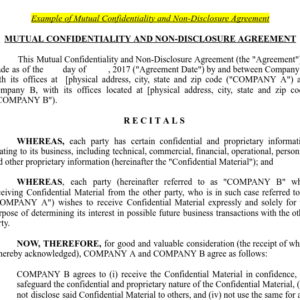
You can find examples of a Unilateral and Bilateral (or Mutual) Non-Disclosure Agreement by clicking on the links below.
https://getyourpurchasingdocuments.com/product/non-disclosure-agreement-nda-unilateral/
https://getyourpurchasingdocuments.com/product/non-disclosure-agreement-nda-mutual/
FAQ – NON-DISCLOSURE AGREEMENT IN PROCUREMENT
What does a Non-Disclosure Agreement protect?
It protects confidential information such as pricing data, forecasts, engineering drawings, intellectual property, and commercial strategy shared during supplier engagement.
Is a Non-Disclosure Agreement legally enforceable?
Yes, when properly drafted with clear scope, reasonable duration, and defined remedies. Enforceability depends on clarity and jurisdiction.
What is the difference between unilateral and mutual NDA?
A unilateral NDA protects one party’s disclosures. A mutual NDA protects both parties when exchanging confidential information.
Should an NDA be signed before RFQ?
Yes. Best practice requires execution before issuing RFQ documents or sharing cost breakdown requirements.
How long should confidentiality last?
Duration depends on the sensitivity of the information. Trade secrets may require extended protection.
Can a supplier challenge NDA enforceability?
Yes, particularly if scope is vague or the signing party lacked authority.
If you would like to learn more about Non-Disclosure Agreements, please click on one of the links below.
Monday – Friday: 9:00 AM – 5:00 PM CST
Other Dates and Times: By Appointment Only
469.500.3040
4705 Melrose Park Ct
Colleyville, Texas 76034
New Documents Coming Soon:
Site by DFW Website Designers
Sign up to stay informed on the latest news and exclusive offers from Get Your Docs.