


Newsletter
Sign up to stay informed on the latest news and exclusive offers from Get Your Docs.


$399.95
Supplier Operations Audit: Why Planning, Procurement, and Logistics Matter
A Supplier Operations Audit is one of the most effective risk-reduction tools a company can deploy before awarding spend to a new supplier. While price, quality certifications, and references matter, they rarely tell the full story. The real risks live inside a supplier’s planning discipline, procurement controls, and logistics execution. A structured audit brings those risks into the light—before they disrupt production, inventory, or customer commitments.
Companies that skip this step are often surprised later by missed lead times, material shortages, poor schedule adherence, or weak internal controls. A Supplier Operations Audit replaces assumptions with ‘firsthand’ evidence and provides decision-makers with a clear view of a supplier’s operational readiness.
What Is a Supplier Operations Audit?
A Supplier Operations Audit is a structured evaluation of how a potential supplier plans production, buys materials, and serves customers. It goes beyond financial stability or ISO certificates and focuses on whether the supplier can consistently fulfil your business requirements.
This type of audit is commonly used during supplier onboarding, strategic sourcing events, or when qualifying a critical or sole-source supplier. It also complements broader supplier risk assessment efforts by identifying operational weaknesses that may not appear in traditional risk scoring models.
A valuable tool, and precursor to an on-site Supplier Operations Audit, can be a request to a potential supplier for a completed Supplier Self-Assessment Survey. The information obtained helps you pre-screen suppliers so that valuable resources needed for on-site visits are used wisely. You can see and download an example using this link.
https://getyourpurchasingdocuments.com/product/supplier-self-assessment-survey/
In addition, if your company hasn’t already done so, you may need to complete a Non-Disclosure Agreement (NDA) with your prospective source prior to getting a Supplier Self-Assessment Survey. You can download an example of this document using the following link.
https://getyourpurchasingdocuments.com/product/non-disclosure-agreement/
Supplier Operations Audit of Planning Capabilities
Planning is where most supplier failures quietly begin. An audit of planning capabilities evaluates how a supplier forecasts demand, schedules production, manages sales orders, and controls production. Weak planning processes often result in expediting, missed deliveries, and excess inventory—costs that are eventually absorbed by the customer.
Key focus areas include demand visibility, sales orders and contracts, production scheduling logic, capacity constraints, and how changes are managed. A supplier with disciplined planning processes demonstrates control, transparency, and the ability to respond to volatility. These findings should directly support and update your supplier risk assessment and ongoing risk mitigation plans.
Supplier Operations Audit of Procurement Controls
Procurement inside a supplier’s organization is a major risk multiplier if left unchecked. A Supplier Operations Audit examines how the supplier controls procurement from sourcing and procuring raw materials to managing sub-tier suppliers with regards to business continuity planning for disruption.
To see an example of a Purchase Order form, click on the link below.
https://getyourpurchasingdocuments.com/product/purchase-order-form/
To find an example of Purchase Order Terms and Conditions, please follow this link.
https://getyourpurchasingdocuments.com/product/purchase-order-ts-and-cs/
Poor procurement controls can lead to material shortages, quality issues, and uncontrolled cost increases. During the audit, companies should evaluate supplier approval processes and purchase order discipline, lead time management, and how exceptions are handled. These insights align closely with supplier performance scorecard metrics such as on-time delivery, quality performance, and cost stability.
If you would like to see an example of a Supplier Performance Scorecard, please follow the link below.
https://getyourpurchasingdocuments.com/product/supplier-performance-scorecard/
Supplier Operations Audit of Logistics and Delivery Performance
Logistics execution is where operational issues become visible to customers. A Supplier Operations Audit reviews how materials are received, stored, packed, and shipped, along with how delivery performance is measured and corrected.
This includes warehouse organization, inventory accuracy, shipping documentation, and carrier management. Weak logistics processes increase the risk of shortages, damaged goods, and missed customer commitments. Findings from this section should feed directly into logistics-related performance metrics and corrective action tracking within your supplier performance framework.
How a Supplier Operations Audit Reduces Supply Chain Risk
The primary value of a Supplier Operations Audit is risk reduction. By validating planning discipline, procurement controls, and logistics capability upfront companies can avoid onboarding suppliers that lack the maturity required to support their operations.
Audit results also provide objective data that strengthens contract negotiations. Identified gaps can be addressed through corrective action plans, service level agreements, and clearly defined expectations embedded within supplier contracts and terms & conditions. This creates accountability before problems occur, not after.
You can learn more about reducing Procurement Operations Risk by standardizng your company’s procurement processes by reading the article, “Essential Procurement Document Toolkit: Ready-to-Use Templates for Smarter Purchasing and Cost Control” by following this link:
When to Perform a Supplier Operations Audit
A Supplier Operations Audit should be conducted when qualifying a new or critical supplier or when expanding an existing supplier’s scope. It is also valuable when there are repeated performance issues or as part of a broader supplier development initiative.
Organizations that institutionalize this audit process build more resilient supply chains, reduce firefighting, and build ‘trust’ with long-term suppliers that translate into higher levels of supplier performance.
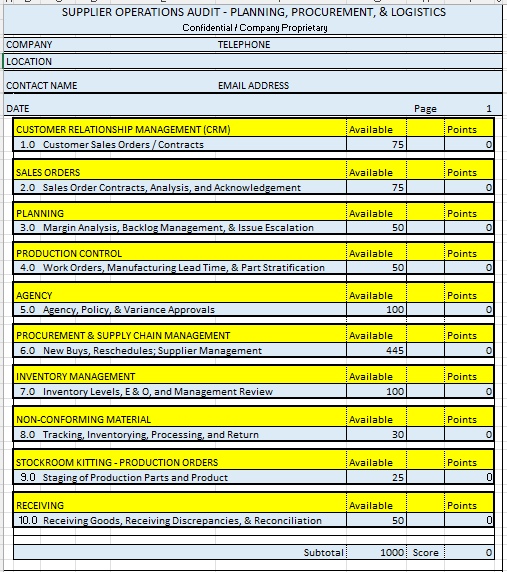
You can find an extensive Supplier Operations Audit – Planning, Procurement and Logistics at GetYourPurchasingDocuments.com by following the link below.
You can also learn more about supplier audits by accessing the link below.
https://www.deltek.com/en/manufacturing/qms/supplier-quality-management/supplier-audit

$199.95
Supplier Performance Scorecard: Turning Business Goals into Measurable Supplier Accountability
A Supplier Performance Scorecard is one of the most powerful—and frequently misunderstood—tools in modern procurement. Too often, companies treat supplier evaluation as an annual formality or a subjective performance review. In reality, a properly designed Supplier Performance Scorecard is a control system: it translates company business objectives into measurable supplier behavior and enforces accountability across the supply base.
When suppliers are not measured consistently, performance drifts. Prices creep upward, delivery reliability erodes, quality problems increase, and procurement loses leverage. A Supplier Performance Scorecard closes that gap by defining what “good” (and ‘great’) looks like—objectively, quantitatively, and defensibly.
If you would like to start measuring your supply base’s performance, you can begin by downloading a copy of a Supplier Performance Scorecard using the link below.
https://getyourpurchasingdocuments.com/product/supplier-performance-scorecard/
Why a Supplier Performance Scorecard Matters to the Business
Every company has supplier expectations, whether they are written down or not. Cost discipline, on-time delivery, quality conformance, responsiveness, and compliance are not optional behaviors; they are prerequisites for operational stability. A Supplier Performance Scorecard formalizes these expectations and aligns them with business goals for suppliers.
Instead of debating anecdotes, procurement teams can point to metrics. Instead of reacting to failures, organizations can identify trends early. This is the difference between managing suppliers and hoping suppliers manage themselves.
Core Components of an Effective Supplier Performance Scorecard
A robust Supplier Performance Scorecard focuses on performance categories that directly support business outcomes. While the exact ‘weighting’ of specific metrics will vary by organization, most scorecards include:
Some organizations include a ‘documentation and administrative’ score to highlight problems with paperwork and inefficiency.
These metrics form the backbone of supplier performance measurement and remove subjectivity from supplier evaluation.
A Supplier Performance Scorecard Aligns Suppliers with Company Business Goals
A Supplier Performance Scorecard should never exist in isolation. Its real power comes from alignment with broader procurement and operational objectives. If the business is focused on cash flow, delivery reliability and inventory turns should be weighted heavily. If quality problems are driving customer dissatisfaction, supplier quality performance must dominate the scorecard.
This alignment ensures suppliers are not just performing well—but performing well in ways that matter to the company.
Furthermore, alignment and weighting can change over time to identify new challenges and opportunities.
Supplier Performance Scorecard and Risk Management
Supplier risk rarely appears without warning. Late deliveries, an increase in quality issues, and contract non-compliance are early indicators. By integrating scorecard results into a Supplier Risk Assessment, procurement teams can proactively identify high-risk suppliers before disruptions occur.
You can find an example of a Supplier Self-Assessment Survey that assists in reviewing a company’s capabilities by following the link below:
https://getyourpurchasingdocuments.com/product/supplier-self-assessment-survey/
Scorecards also support segmentation strategies, allowing organizations to focus development efforts on strategic suppliers while placing transactional suppliers under tighter control.
The Value of a Supplier Performance Scorecard in Supplier Performance Reviews
A Supplier Performance Scorecard becomes exponentially more effective when it is tied to formal Supplier Performance Reviews or and contractual terms. Scorecard results provide a factual basis for quarterly or annual reviews, eliminating emotional debates and anchoring discussions in data.
When referenced in supplier contracts, scorecards support:
This connection or link turns the scorecard from a measurement tool into a governance mechanism.
Best Practices for Supplier Performance Scorecard Implementation
To deliver value, a Supplier Performance Scorecard and the business expectations must be:
A standardized scorecard also ensures continuity when personnel change and provides evidence during internal or external audits.
Download a copy of a Supplier Performance Scorevcard today using the link below.
https://getyourpurchasingdocuments.com/product/supplier-performance-scorecard/
From Measurement to Continuous Improvement
The ultimate purpose of a Supplier Performance Scorecard is not punishment, it is improvement. By clearly defining expectations and measuring results, companies create a feedback loop that drives better supplier behavior, stronger relationships, and improved business performance. When supplier performance is measured correctly, accountability stops being personal and starts being professional.
You can read more about Supplier Performance management by clicking on the link below.
https://www.ivalua.com/blog/supplier-performance-management/

$399.95
Supplier Self-Assessment Survey
Most supplier failures do not start in production. They start much earlier—during discovery—when organizations move suppliers forward based on incomplete information, assumptions, or sales-driven optimism. Once engineering time, contracts, and tooling are committed, the cost of discovering weaknesses multiplies quickly.
A Supplier Self-Assessment Survey exists to prevent that mistake.
Used correctly, it acts as the first formal control point in the supplier onboarding process. It forces transparency, establishes baseline expectations, and provides documented evidence that a potential supplier is ‘capable of supporting’ your operational, quality, financial, and compliance requirements before they are treated as a viable source of supply.
This is not bureaucracy. It is risk management at the cheapest possible moment.
Before Supplier Engagement and a Supplier Self-Assessment Survey, Complete a Non-Disclosure Agreementment
A Non-Disclosure Agreement is one of the most fundamental yet frequently delayed documents in procurement and supplier management. It exists for a simple reason: once sensitive information leaves your organization, control is gone unless legal boundaries are already in place.
A well-structured Non-Disclosure Agreement establishes disclosure restrictions, defines ownership of information, and creates legal enforceability before any meaningful business conversation begins.
If you need a copy of a Non-Disclosure Agreement (NDA), you can find a copy at
https://getyourpurchasingdocuments.com/product/non-disclosure-agreement/
Discovery Phase: Why Supplier Discovery Without Structure Fails
In many organizations, supplier discovery begins with emails, phone calls, and slide decks. Capabilities are described verbally. Certifications are “available upon request.” Lead times are estimated. Financial stability is typically assumed to be good once a preliminary financial review is completed. None of these issues are completely verifiable or auditable.
This is where the ‘supplier discovery phase’ often begins to break down.
Without a standardized intake mechanism, procurement teams unintentionally:
A structured Supplier Self-Assessment Survey replaces assumptions with documented inputs.
The Supplier Self-Assessment Survey as a Discovery Gate
A Supplier Self-Assessment Survey formalizes discovery by requiring suppliers to self-declare their capabilities, controls, and constraints in writing. It transforms discovery from conversation into data.
At this stage, the objective is not approval. The objective is filtering.
Key discovery-phase benefits include:
When discovery is disciplined, qualification becomes faster—and approval becomes defensible.
Qualification Phase: A Supplier Self-Assessment Survey Turns Supplier Claims into Evidence
The Supplier Self-Assessment Survey is the foundation of the supplier qualification process. It captures structured information across the dimensions that actually matter in operations, including:
This information allows procurement teams to perform a targeted supplier risk assessment without launching full audits prematurely.
Self-reported does not mean unverified—it means triaged.
A Supplier Self-Assessment Survey: Supporting Due Diligence Without Slowing Down the Business
One of the most overlooked advantages of a Supplier Self-Assessment Survey is how well it supports supplier due diligence without creating friction.
Instead of:
The survey enables:
This is how high-performing procurement teams balance speed and control.
Linking the Supplier Self-Assessment Survey to Vendor Risk Assessment
When survey responses are reviewed consistently, they feed directly into a broader supply chain risk assessment framework. Patterns emerge quickly:
By identifying these issues during qualification, organizations protect themselves from downstream disruptions, corrective actions, and supplier exits that destroy value.
If you need a copy of a Supply Chain Risk Assessment tool, you can find it by clicking this link:
https://getyourpurchasingdocuments.com/product/supply-chain-risk-assessment/
Governing the New Supplier Approval Process that Begins with the Supplier Self-Assessment Survey
Advancing a supplier to approved status without documented qualification exposes the organization to operational, financial, and legal risk. Approval must be earned, not implied.
A Supplier Self-Assessment Survey creates the documentary backbone for the new supplier approval process. It supports:
Approval decisions become traceable, defensible, and repeatable. Many companies ‘bake’ the approval authority for supplies into their Approval Limits or Authorization to Commit Funds matrix.
If you need an example of an Approval Limits in Purchasing table, you can find one by following the link below.
https://getyourpurchasingdocuments.com/product/approval-limits-in-purchasing/
From Supplier Self-Assessment Survey to the Approved Supplier List
Once reviewed and validated, survey data supports decisions on whether a supplier can be added to the approved supplier list process. When combined with:
The organization moves from informal sourcing to governed supply base expansion.
This is how procurement protects the enterprise while enabling growth.
Operational Value: What the Supplier Self-Assessment Survey Actually Prevents
The operational value of a Supplier Self-Assessment Survey is not theoretical. It prevents downstream operational failures such as:
By requiring disclosure early, procurement shifts risk left—where it is cheapest to address and it strengthens internal controls and audit readiness. From an internal control’s perspective, the survey:
For organizations subject to customer audits, ISO requirements, or regulatory oversight, this documentation is non-negotiable.
Supplier Self-Assessment Surveys Support Integration with Contracts, Risk, and Performance Management
The Supplier Self-Assessment Survey, if filled out completely, allows the organization to know much more about who it is dealing with. This aligns supplier expectations with the company before any legal commitments are made. This is pre-contract protection through alignment.
Survey findings often inform:
This is governance, not paperwork. It feeds supplier performance and continuous improvement. Once approved, survey responses become baseline data for ongoing supplier management. They inform:
A survey completed once—but referenced often—delivers long-term value.
Why Mature Procurement Teams Standardize This Step
Organizations with disciplined procurement functions do not treat supplier discovery as informal networking. They treat it as a controlled business process.
A standardized Supplier Self-Assessment Survey:
In short, it professionalizes supplier onboarding.
Conclusion: A Supplier Self-Assessment Survey is the Least Expensive Risk Control You Will Ever Implement
Requiring suppliers to complete a Supplier Self-Assessment Survey before advancing them in the discovery phase is one of the highest-ROI controls available to procurement.
It costs little.
It scales easily.
It prevents expensive mistakes.
More importantly, it signals maturity—to suppliers, auditors, and internal stakeholders alike.
Organizations that skip this step do not move faster. They simply defer risk until it becomes costly, public, and difficult to unwind.
If you are interested in downloading a copy of Supplier Self-Assessment Survey, you can access the file by following the link below.
https://getyourpurchasingdocuments.com/product/supplier-self-assessment-survey/
You can learn more about supplier qualifications and evaluation by accessing the information in this link:

$199.95
Supply Chain Risk Assessment: A Winning Core Procurement Process and Discipline
A Supply Chain Risk Assessment is no longer a theoretical exercise reserved for enterprise risk committees or post-mortem presentations. It is a practical, repeatable discipline that procurement and supply chain leaders must own if they want to protect margin, continuity, and credibility. Global sourcing, lean inventories, geopolitical volatility, labor constraints, and supplier fragility have turned unmanaged risk into a measurable financial liability.
At its core, a Supply Chain Risk Assessment identifies where a company is exposed, how severe that exposure is, and what actions are required to reduce it. This discipline connects strategy to execution by translating uncertainty into structured decisions procurement teams can manage.
The Supply Chain Risk Assessment Process Starts with Visibility
An effective Supply Chain Risk Assessment begins with a structured supply chain risk assessment process. You cannot mitigate what you cannot see. Procurement must first establish visibility across suppliers, materials, services, logistics lanes, and operational dependencies.
This includes mapping tier-one suppliers and, where risk is elevated, extending into tier-two and tier-three dependencies. Lead times, geographic concentration, capacity constraints, financial stability, quality history, and compliance posture all feed into a formal supply chain risk analysis. Without documented inputs, risk discussions remain opinion-driven and inconsistent.
Tools such as Supplier Self-Assessment Surveys and Supplier Operations Audits—like those hosted on GetYourPurchasingDocuments.com—provide standardized data collection and create a defensible starting point for analysis.
You can find an example of an in-depth Supplier Self-Assessment Survey by following the link below.
https://getyourpurchasingdocuments.com/product/supplier-self-assessment-survey/
Supply Chain Risk Assessment as a Procurement Departmental Control
A Supply Chain Risk Assessment is inseparable from procurement risk assessment. Every sourcing decision introduces risk, whether through single-source dependencies, aggressive cost targets, or extended global lead times. When procurement evaluates suppliers purely on price, risk compounds silently.
Embedding risk assessment in procurement ensures that sourcing strategies consider continuity, financial exposure, and operational resilience alongside unit cost. This shifts procurement from reactive expediting to proactive supply chain risk management.
Supplier risk assessment activities should be aligned with approval limits, sourcing thresholds, and contract governance so that high-risk suppliers trigger additional scrutiny before—not after—issues occur.
If you need more information about developing Approval Limits at your company, you can learn more about this topic by following this link.
https://getyourpurchasingdocuments.com/product/approval-limits-template/
Supply Chain Risk Assessment and Operational Exposure
One of the most overlooked dimensions of a Supply Chain Risk Assessment is operational risk in supply chain execution. Even financially stable suppliers can introduce disruption through poor production controls, inadequate inventory management, or weak quality systems.
Operational risks show up as missed deliveries, premium freight, line shutdowns, and excess inventory buffers. These risks are measurable, predictable, and preventable when procurement works cross-functionally with operations, quality, and finance.
Learn more about Receiving documentation by clicking on the following link:
https://getyourpurchasingdocuments.com/product/goods-received-note/
Supplier audits, receiving discrepancy tracking, and three-way match discipline provide early warning signals that feed directly into a supply chain risk framework.
Supply Chain Risk Assessment Enables Targeted Mitigation
Risk identification without action is just ‘theater.’ A Supply Chain Risk Assessment must directly drive supply chain risk mitigation. Not every risk requires elimination; many require intelligent buffering, dual sourcing, or contractual protection.
High-impact risks often demand supplier risk management actions such as alternate source qualification, safety stock repositioning, or commercial renegotiation. Others may trigger third-party risk assessment reviews to validate financial or compliance exposure.
Mitigation strategies should be documented, assigned owners, and tracked—turning risk from a static report into an active management process.
Supply Chain Risk Assessment Strengthens Resilience and Continuity
A mature Supply Chain Risk Assessment supports supply chain resilience planning and supply chain continuity planning. Resilience is not redundancy for its own sake; it is the ability to absorb disruption without catastrophic cost or customer impact.
Companies that embed risk assessment in procurement decisions outperform peers during disruption because they have already evaluated supply chain vulnerability assessment scenarios and defined response playbooks. This is where leaders with mature vendor risk assessment processes are separated from those leaders and organizations stuck with firefighting.
Supply Chain Risk Assessment as a Living Discipline
The most effective Supply Chain Risk Assessment programs are not annual check-the-box exercises. They evolve as suppliers change, markets shift, and business strategies adapt. Risk assessment in procurement must be revisited after major sourcing events, acquisitions, supplier changes, or demand shifts.
When supported by standardized documentation, scorecards, and audits—like those available through MSCSgrp.com—risk assessment becomes embedded in daily procurement operations rather than siloed in compliance.
You can download an example of a Supply Chain Risk Assessment form here that includes assigning ‘risk’ and developing risk mitigation’ plans.
https://getyourpurchasingdocuments.com/product/supply-chain-risk-assessment/
Bottom Line: Supply Chain Risk Assessment Protects Margin Before It Protects Supply
A Supply Chain Risk Assessment is ultimately about protecting financial performance. Disruptions destroy margin long before they impact customer relationships. Procurement leaders who institutionalize risk assessment gain control, predictability, and credibility across the enterprise.
You can find out more about Supply Chain Risk Assessment by visiting the following link:
Monday – Friday: 9:00 AM – 5:00 PM CST
Other Dates and Times: By Appointment Only
469.500.3040
4705 Melrose Park Ct
Colleyville, Texas 76034
New Documents Coming Soon:
Site by DFW Website Designers
Sign up to stay informed on the latest news and exclusive offers from Get Your Docs.