Most buyers do not lose money because suppliers are bad.
They lose money because they accept a number, they do not fully understand.
A supplier submits a quote. It looks reasonable. It is even competitive. The buyer compares it to other quotes, negotiates a little, and places the order.
On the surface, everything looks fine.
You can download a quotation template here: https://getyourpurchasingdocuments.com/product/request-for-quotation-rfq/
But underneath that single number is a stack of assumptions — material costs, labor rates, overhead allocations, freight, packaging, margin—and the Buyer rarely challenges these costs. And that is where margin quietly disappears.
This is where Purchase Price Cost Analysis changes the game.
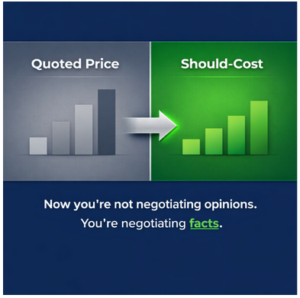
Instead of negotiating a total price, buyers start analyzing the cost structure behind that price. They stop negotiating opinions and start negotiating facts.
What Is Purchase Price Cost Analysis?
Purchase Price Cost Analysis is the structured process of breaking down a supplier’s quoted price into its individual cost elements so a Buyer can understand how the total cost is ‘built.’
The Buyer can request this breakdown of the supplier; however, it may be necessary to obtain agreement to a non-disclosure agreement (bilateral or mutual agreement) since this is a request to disclose financial information, and most suppliers are reluctant to do so.
You can see or download a bilateral or mutual non-disclosure agreement by following the link below:
https://getyourpurchasingdocuments.com/procurement-process/legal/confidentiality/
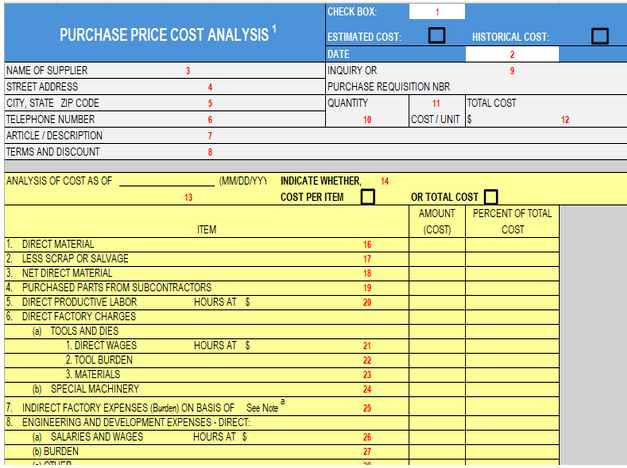
Rather than accepting a lump-sum quote, the buyer evaluates components such as:
- Raw material content
- Direct labor
- Machine or process cost
- Tooling and setup charges
- Packaging
- Freight and Logistics
- Overhead allocation
- Supplier profit margin
- Non-recurring engineering or special charges
This approach transforms a quote from a black box into something transparent, measurable, and actionable.
And once you can see the structure, you can challenge it.
Why Most Buyers Miss the Opportunity
Most organizations rely heavily on price analysis, not cost analysis.
Price analysis compares one supplier’s total price to another. It might look at historical pricing or market benchmarks. It answers the question:
“Is this price competitive?”
But it does not answer the more important question:
“Is this price built correctly?”
That is a dangerous gap.
Because two suppliers could quote the same or close to the same total price and arrive there in completely different ways. One may be efficient and properly structured. The other may be padded with excess margin, inefficient processes, or outdated assumptions.
If you only compare totals, you miss the difference.
And that difference is usually where some 10–15% savings is hiding.
What Buyers Actually See When They Break Down a Quote
When you apply Purchase Price Cost Analysis, the supplier’s quote starts to look very different, especially when compared to a ‘should cost analysis.’
Instead of one number, you now see a cost structure.
For example, a $100 quoted part might break down like this:
- Material: $42
- Labor: $18
- Overhead: $12
- Tooling amortization: $6
- Packaging: $4
- Freight: $8
- Profit: $10
Now the conversation changes completely.
You are no longer asking, “Can you do better on $100?”
You are asking:
- Why is material priced at $42?
- Is the labor assumption based on actual cycle time?
- Is overhead inflated?
- Is freight optimized or padded?
- Is the profit margin aligned with market norms?
That is a very different negotiation.
And suppliers know it.
The Shift: From Price Negotiation to Understanding Cost
Here is the uncomfortable truth most companies ignore:
If you do not understand how a supplier built their price, you are negotiating blindly.
You may win a couple of percentage points here and there, but you are not systematically driving cost out of your supply base.
Purchase Price Cost Analysis changes that dynamic.
It creates a shift from:
- Reactive negotiation → Structured evaluation
- Opinion-based discussions → Data-driven conversations
- Supplier-controlled pricing → Buyer-informed decisions
Once you understand the cost drivers, you gain leverage—not through pressure, but through clarity.
The Business Impact of Purchase Price Cost Analysis
This is not an academic exercise. It directly impacts financial performance.
- Improved Cost Visibility
Instead of accepting total price at face value, buyers gain transparency into how costs are built. This visibility is the foundation of every cost reduction effort. - Stronger Negotiation Position
When you can point to specific cost elements, negotiations become precise. You are no longer asking for a discount—you are asking for justification. - Identification of Hidden Costs
 Suppliers do not always intentionally inflate pricing, but they do operate with assumptions that may not benefit you. Cost analysis exposes those assumptions.
 - Better Supplier Comparisons
Two quotes that look similar at the top line may be quite different underneath. Breaking them down allows true ‘line-by-line’ comparison. - Margin Protection
Every dollar saved in procurement flows directly to EBIT. That is not theory, that’s math. - Procurement Discipline
This approach creates a repeatable process. It removes guesswork and replaces it with structure.
This leads companies to develop a more robust model of ‘Direct and Indirect Cost Analysis Sourcing.’
How Buyers Perform Purchase Price Cost Analysis
This process is not complicated, but it does require discipline.
Step 1: Collect the Supplier Quotation
Start with a detailed quote. If the supplier only provides a lump-sum number, that is your first signal—you need more detail.
Step 2: Identify Cost Elements
Break the quote into logical components: material, labor, overhead, freight, and margin.
Step 3: Separate Direct and Indirect Costs
Direct costs relate to the product itself. Indirect costs include overhead, administrative burdens, and allocations.
For more information on direct and indirect costs, please follow the link below.
https://quickbooks.intuit.com/ca/resources/accounting/direct-vs-indirect-cost/
Step 4: Evaluate Each Component
Ask whether each cost element is reasonable. Compare the Purchase Price Cost Analysis the ‘Should Cost Analysis’ using:
- historical data
- industry benchmarks
- supplier provided data (i.e., completing and returning a purchase price cost analysis)
- internal estimates
- should-cost models
Step 5: Challenge Assumptions
This is where ‘value’ can be created. Question anything that looks inflated, outdated, or unsupported.
Step 6: Compare Across Suppliers
Apply the same structure to multiple quotes (again, developing ‘Direct and Indirect Cost Analysis Sourcing’).
Differences will become obvious quickly.
Step 7: Document Opportunities
Capture where costs can be reduced or where terms can be improved.
Step 8: Negotiate with Facts
Now you are ready to negotiate—not based on pressure, but on understanding.
Purchase Price Cost Analysis vs Price Analysis
This distinction matters more than most companies realize.
Price Analysis looks at total price and compares it to other prices. It answers whether something is competitive.
Purchase Price Cost Analysis breaks down the price into elements and evaluates whether each component is reasonable.
Price analysis tells you if you are in the ballpark.
Purchase Price Cost Analysis tells you if you are overpaying inside that ballpark.
The strongest procurement organizations use both—but cost analysis is where real leverage lives.
Where Cost Gets Lost Inside Supplier Quotes
Even when suppliers deliver the right product on time, lost cost reduction opportunities still happen inside the quote.
Common problems include:
- inflated material assumptions
- outdated labor standards
- inefficient production methods
- excessive overhead allocation
- padded freight estimates
- unnecessary packaging costs
- hidden margin layers
None of this shows up clearly in ‘total price.’
But they show up immediately when you break the quote apart.
The Role of Should-Cost Analysis
‘Purchase Price Cost Analysis’ and a ‘should-cost analysis’ work hand in hand.
Cost analysis breaks down what the supplier is charging.
A ‘Should-cost’ analysis estimates what the product should cost based on materials, labor, and process assumptions.
When you compare the two, gaps become obvious.
That gap is your opportunity.
Why Suppliers Respect This Approach
Here is something most buyers do not realize:
Good suppliers respect structured cost analysis.
Why?
Because it signals that you understand the business.
You are not asking for arbitrary discounts. You are engaging at a professional level.
That changes the tone of the relationship from adversarial to analytical.
Weak suppliers struggle with this.
Strong suppliers lean into it.
Building a Repeatable Procurement Advantage
The real value of Purchase Price Cost Analysis is not a one-time savings event.
It is the creation of a professional and repeatable system.
When Buyers embed this process into their procurement function:
- every quote is evaluated consistently,
- every supplier knows the expectation,
- negotiation is grounded in facts, and
- sourcing decisions improve over time.
That is how procurement moves from transactional to strategic.
Using a Purchase Price Cost Analysis Template
This is where most companies fall short.
They understand the concept, but they do not have a structured way to apply it.
A well-designed template solves that problem by,
- standardizing how cost elements are ‘captured.’
- ensuring consistency across buyers
- reducing analysis time
- improving documentation
- supporting internal approvals
It turns a concept into an operational tool.
When to Use Purchase Price Cost Analysis
Not every purchase requires deep analysis, but certain situations demand it:
- custom or engineered products
- products and items in ‘large spend’ Categories
- significant price variation between suppliers
- unclear or inconsistent quotations
- long-term supply agreements
- cost reduction initiatives
In these cases, skipping cost analysis is not efficient, it is risky.
Common Mistakes Buyers Make
Even when companies attempt cost analysis, they often miss the mark.
Here are the most common mistakes:
Accepting incomplete data
If the supplier does not provide enough detail, push for it.
Overcomplicating the process
Focus on the major cost drivers first.
Failing to challenge assumptions
Analysis without action is just paperwork.
Not documenting results
If you do not capture insights, you cannot scale them.
Treating it as a one-time exercise
The real value comes from repetition.
The Bottom Line
Procurement is not about placing orders.
It is about controlling cost.
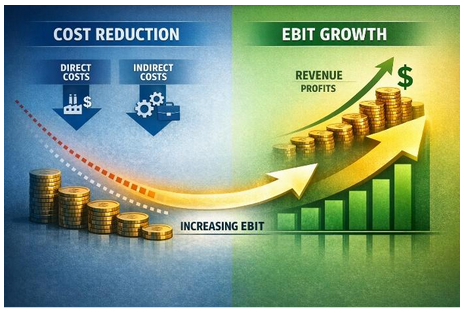
Purchase Price Cost Analysis gives buyers the ability to see inside the price, understand the drivers, and make informed decisions that directly impact the company’s financial performance.
It replaces guesswork with structure.
It replaces opinion with data.
And it turns procurement into what it should be: A driver of margin.
Final Thought
Stop negotiating total price.
Start analyzing cost structure.
That is where the real savings are.
If your organization is still reviewing supplier quotes at the total price level, you are leaving money on the table.
A structured Purchase Price Cost Analysis template can immediately bring visibility, control, and consistency to your procurement process.
You can download a copy of a Purchase Price Cost Analysis template by following the link below.
https://GetYourPurchasingdocuments.com/product/purchase-price-cost-analysis/
Or, if you want to go deeper, schedule a brief discussion and we can walk through how to apply this approach to your current supplier base.
Let us talk: 469-500-3040
You can also learn more about Purchase Price Cost Analysis by following the link below:
https://preferredcfo.com/insights/cost-analysis-and-price-analysis/