How Manufacturers Can Cut Manufacturing Costs
Companies have seen quality and cost issues as mortal enemies for decades. One side pulls, the other side snaps, and leadership throws up their hands as if “good, fast, cheap—pick two” is a universal law of physics. But manufacturers who understand disciplined procurement know a better truth:
At GetYourPurchasingDocuments.com and Manufacturing and Supply Chain Services, this is the daily reality where they help customers achieve goals.
You absolutely can cut manufacturing costs by 10–15% without touching your product design, lowering specifications, or upsetting customers—if you bring structure, control, measurement, and strategic supplier management into the equation.
Most organizations do not have a cost problem—they have a process problem masquerading as a cost problem. Standardizing documentation, tightening supplier governance, and sharpening sourcing decisions delivers savings that stick. No shortcuts. No reduced quality. No drama.
This long-form guide is your blueprint for capturing those savings in a sustainable, scalable way.
Why Manufacturers Cannot Cut Manufacturing Costs – Savings Hiding in Plain Sight
At times, the management team believes that cutting costs is a blunt-force activity – suppliers squeeze pricing, slash headcount. That is not strategy; that is panic dressed up as a solution.
The truth is far simpler and far more effective: Cutting Manufacturing Costs is much easier than companies think. Yes, it takes planning and execution, but waste also hides in unstructured purchasing. Inefficiency hides in unclear expectations and processes. Cost missteps happen at the company when internal control is missing, the procurement process does not have structure, and the company does not measure suppliers and their performance.
Manufacturers who install a disciplined, documented procurement system routinely unlock:
- Lower material, freight, and overhead costs
- Achieve significant working-capital improvement.
- Higher supplier accountability and fewer defects
- A supply chain that does not fall apart when someone makes a mistake in a port halfway across the world.
And they do it without ever touching product design or engineering specifications.
Four pillars drive these savings:
- Process discipline
- Supplier optimization
- Total Cost of Ownership (TCO) visibility
- Contract and performance governance.
Let us break each one down and show how the savings stack up.
Step 1: Cut Manufacturing Costs by Replacing Chaos with Process (3–5% Savings)
Unstructured purchasing is a silent budget killer. It starts innocently enough—emails, phone calls, casual approvals, “I thought you ordered that,” and prices that drift upward when no one is watching. But the result is the same every time:
- Missed volume discounts.
- Rogue spending.
- Lack of traceability.
- Confusion between departments.
- Inaccurate supplier invoices.
Companies must control their purchasing processes just like their production process. Otherwise, costs will creep upwards and out run savings.
The Fix: Cut Manufacturing Costs by Standardizing the Procurement Process and Documentation
This is where tools like those at GetYourPurchasingDocuments.com become non-negotiable because they help organize, control, and manage company ‘spend.’ Here are seven ways to improve your company’s procurement operation.
Protect your IP by using Unilateral and Bilateral NDAs. You can find examples at,
https://getyourpurchasingdocuments.com/product/non-disclosure-agreement-template/
Download a Purchase Requisition template and eliminate rogue spending.
https://getyourpurchasingdocuments.com/product/complete-purchase-requisition-form/
Evaluate new suppliers quickly and easily by having them return a structured ‘Supplier Self-Assessment Survey.’
The Supplier Self-Assessment template forces suppliers to disclose:
- Operational capabilities
- Certifications
- Quality systems
- Financial stability
- Capacity constraints
- Sub-supplier dependencies
- Environmental and compliance programs
This reveals which suppliers are truly world-class—and which are liabilities waiting to explode. You can find a complete Supplier Self-Assessment at,
https://getyourpurchasingdocuments.com/product/supplier-self-assessment-survey/
Use the RFQ template to increase competition and capture total cost input details, not just unit price, and have it work as a quote summary.
https://getyourpurchasingdocuments.com/product/request-for-quotation-rfq/
Standardize your purchasing workflow with a Purchase Order Template
https://getyourpurchasingdocuments.com/product/purchase-order-form/
Ensure supplier contract compliance using PO Terms and Conditions
https://getyourpurchasingdocuments.com/product/purchase-order-ts-and-cs/
Require a Goods Receipt Note or Receiving Log from your Receiving department for consistent communication, three-way-match, and inventory accuracy.
https://getyourpurchasingdocuments.com/product/goods-received-note/
By using these basic tools and creating a closed-loop procurement system, you will be able to cut manufacturing costs.
Suddenly every transaction becomes:
- A standardized process
- Transparent
- Traceable
- Formally approved
- Managed cost-control and savings.
- Audit-ready
- Protected from “informal interpretation.”
Companies adopting standardized procurement tools reliably cut manufacturing costs by 3–5% simply by eliminating chaos, leveraging, competing their purchases, and enforcing consistency in the purchasing process.
A structured Purchasing process flow reduces manufacturing costs. A flow chart follows this brief outline.
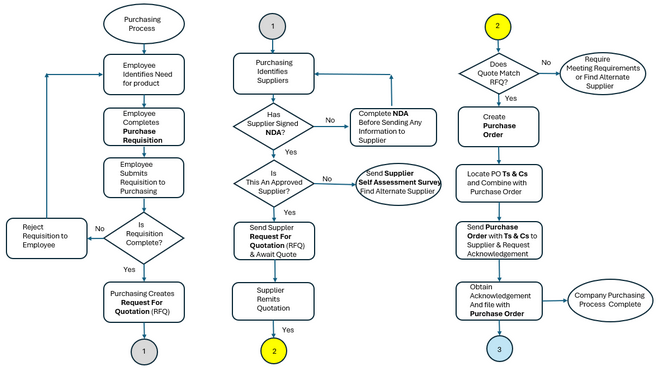
- An employee or requestor identifies a need for material or service.
- The requester completes a company approved standardized Purchase Requisition (PR).
- The requestor submits the requisition to Purchasing for review.
- If the PR is complete, the Buyer creates a Request for Quotation (RFQ).
- If the PR is incomplete, Procurement returns the PR to the requester identifying the reason for its rejection and asked to correct any errors and resubmit the PR.
- When in possession of a completed PR, the Buyer identifies suppliers that can provide the product or service.
- If the company has approved suppliers, the Buyer confirms that the supplier is active and has completed non-disclosure agreement (NDA).
- If there are not any approved suppliers, or if a previously approved supplier has an inactive or expired NDA, the Buyer contacts the supplier to complete an NDA.
- Once there is a complete NDA on file, the Buyer checks to see if the supplier is an approved supplier.
- If the supplier is an approved supplier, the Buyer can send the supplier the RFQ.
- If the supplier is not an approved supplier, then the Buyer starts the supplier approval process and asks the supplier to complete and return a Supplier Self-Assessment Survey.
Note: If the supplier is not an approved, the company must begin the process for approval. Supplier approval is an extensive process and outside the scope of this article.
- Once a supplier has an NDA in place and is an approved supplier, the Buyer sends the RFQ requesting pricing.
- When the supplier returns a complete quotation, the Buyer reviews the quotation to see if it matches the requirement(s) on the PR and RFQ.
- If the quotation does not match the RFQ and Purchase Requisition, the quotation is incomplete and the Buyer contacts the supplier.
- If the quotation and requirements match the RFQ and PR, the Buyer will decide if the pricing, quantities, and other information is acceptable. For this example, we consider the quotation to be acceptable.
- The Buyer creates a purchase order (PO).
- The Buyer combines the PO with the Purchase Order (PO) Terms and Conditions (Ts & Cs) and transmits these documents to the supplier requesting an Acknowledgment of the PO.
Note: For this exercise we will assume that the supplier agrees with the PO and Ts & Cs as written and acknowledges the PO in writing.
- The Buyer files the PO and acknowledgement.
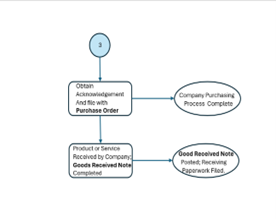
- At this point the company purchasing process is complete.
- The Next step for Purchasing is to monitor the ‘Open Order’ Report and ensure delivery of product(s) or completion of service(s).
- Upon receipt of the product or performance of service at the company, the Receiving department 1) verifies the delivery of the product or completion of the service and 2) that the packing list matches the delivered goods or the service(s) performed. This should also match the requirements of the PO. Once verified, the Receiving department will complete a Good Received Note or Log the Receipt on a Receiving log and in the ERP / MRP system (if applicable).
Note: In this example we will assume that the delivery of product or service provided meets the requirements on the purchase order.
- The Receiving department files the packing list(s) and Bill of Lading (if applicable) should a review by the company be needed.
Step 2: Cut Manufacturing Costs by Measuring Your Supplier Base (3–5% Savings + Quality Gains)
As the saying goes: You cannot manage what you do not measure.
Most manufacturers work with too many suppliers—often because no one has ever stepped back to ‘analyze’ performance, redundancy, or total ‘spend.’ A bloated supply base inflates:
- Pricing
- Variability
- Risk
- Administrative workload
- Missed opportunities for leverage.
Step 3: Cut Manufacturing Costs by Focusing on Total Cost of Ownership (TCO), Not Unit Price (5–8% Savings)
Chasing the lowest piece price is a ‘rookie’ move. It is the procurement equivalent of buying the cheapest car on the lot and then acting surprised when the ‘high dollar’ repair bills show up draining your bank account. Unit price is only one slice of the ‘total’ cost picture.
The Real Cost Drivers Include:
- Freight and fuel surcharges
- Packaging requirements
- Lead time, Safety Stock, and inventory carrying cost.
- Payment terms
- Minimum order quantities
- Rework and scrap.
- Supplier reliability.
- Engineering or change-order costs.
When companies rely on informal RFQs such as emails, spreadsheets, phone calls, these cost drivers remain invisible. If allowed, Suppliers will quote different prices based on different conditions and leave it up to the Buyer to sort through the information.
The Fix: Cut Manufacturing Costs by Using a Formalized RFQ Template, Process and Summary
Construct a formal RFQ templated and RFQ process allowing your company to quote multiple suppliers and compare these quotes because you uncover:
- Total manufacturing lead time
- Freight Costs
- Packaging Costs (separately itemized)
- Tool and Die Expenses
- Customs and Duty Costs
- Overly restrictive payment terms
- Excessive order quantities
Manufacturers focusing on TCO—not sticker price—gain 5–8% additional savings across categories.
Download the forms you need using the links listed above.
Step 4: Contract Smart — Protect Your IP, Your Margins, and Your Reputation

A handshake does not hold up in court, and “they promised us” never survives a dispute.
Manufacturers without formal supplier agreements risk:
- Losing intellectual property
- Being stuck with inferior performance.
- Misaligned expectations.
- Cost increases without recourse.
- Supply interruptions with no penalty.
- Disputes over tooling, ownership, or payment terms
The solution is simple and essential.
Manufacturing supplier contracts ensure IP protection and quality compliance.
Use Clear, Legal Frameworks for Every Supplier Relationship
Documents at GetYourPurchasingDocuments.com, i.e.,
- Non-Disclosure Agreements, either Bilateral or Unilateral
- Purchase Order Templates
- PO Terms & Conditions
…creating the legal foundation that protects:
- Engineering drawings and technical data
- Proprietary manufacturing designs and processes
- Tooling ownership
- Pricing structures
- Delivery commitments
- Confidential business information
- Quality standards
GetYourPurchasingDocuments.com and MSCSgrp.com integrates these agreements into strategic sourcing frameworks that link:
- Operational goals
- Pricing models
- Capacity planning
- Supplier metrics
- Financial and compliance objectives
Contracts are not paperwork. They are risk insurance.
Step 5: Cut Manufacturing Costs by Measuring, Reviewing, and Improving Supplier Performance (the Hidden Engine Behind Sustainable Savings)
Once the company selects suppliers, the real work begins. Performance drifts unless tied to expectations and then measured and reviewed. This allows the company to decide whether to give existing suppliers more business, maintain the present level of business, or find additional sources of supply.
Manufacturers who “set it and forget it” experience:
- Rising defect rates
- Late product deliveries
- Gradual ‘price creep’
- Deteriorating responsiveness
- Zero continuous improvement
Supplier Scorecards Create High-Performance Partnerships
Scorecards can track different variables such as:
- Quality PPM
- On-time delivery
- Cost competitiveness
- Responsiveness and communication
- Timeliness of Corrective-actions
- Innovation and value-engineering participation
Companies that conduct quarterly business reviews with suppliers create a culture of transparency:
- High performers rise.
- Low performers improve—or exit.
- New opportunities for savings surface naturally.
GetYourPurchasingDocuments.com and mscsgrp.com helps manufacturers implement KPI dashboards that tie procurement performance directly to:
- Production planning.
- Inventory management.
- Finance / cash-flow.
- Supplier Performance.
Example of a Supplier scorecard driving continuous improvement in business and quality measurements.
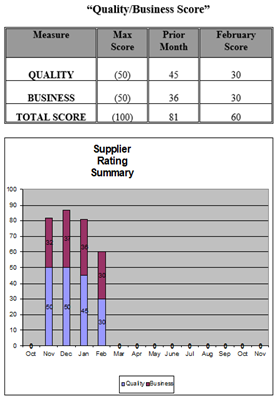
Strong measurements do not just protect cost, they amplify quality.
Through https://GetYourPurchasingDocuments.com , learn how companies can run structured supplier performance programs that evaluate:
- Cost
- Delivery
- Quality
- Responsiveness
You can find an example of a Supplier Performance Scorecard at the link below.
https://getyourpurchasingdocuments.com/product/supplier-performance-scorecard/
The Bottom Line: Discipline, Process, and Execution Pays — Always
Manufacturers who embrace structured procurement gain three advantages simultaneously:
- Reduced cost (10–15% easily achievable)
- Reduced risk (legal, operational, financial, and supply chain)
- Improved quality and delivery consistency
This happens because the organization shifts from reactionary purchasing to systematic procurement excellence.
The Playbook Works Because It:
- Removes variability from processes.
- Controls decisions
- Improves transparency.
- Strengthens supplier capabilities and performance.
- Eliminates hidden cost drivers.
- Protects the company when using contracts.
- Holds suppliers accountable with metrics.
- Creates alignment between procurement, operations, and finance.
Cost savings become predictable.
Quality becomes consistent.
Operations run smoother.
Leadership sleeps better.
Manufacturing plant operating efficiently after procurement process improvements.

Start improving your purchasing process today:
- Explore Procurement Templates → https://GetYourPurchasingDocuments.com/
- Learn About Supplier Optimization Consulting → https://mscsgrp.com