Newsletter
Sign up to stay informed on the latest news and exclusive offers from Get Your Docs.


Free
Approval Limits in Purchasing is not a bureaucratic hurdle — it’s a critical safeguard approved by executive management that defines who can commit company funds, at what level, and under what circumstances. And when companies expand, complexity multiplies and without structured controls, purchasing decisions can become a breeding ground for overspending, compliance failures, or even fraud. But an Approval Limits in Purchasing matrix reduces risk, ensures financial discipline, and protects company assets from misuse.
At its core, an Approval Limits in Purchasing Table serves as a company’s internal firewall between legitimate business expenditures and potential financial exposure. It ensures that only authorized individuals with designated budget and role-based authority—can approve expenditures or sign contracts on behalf of the organization. Without this clarity, even well-intentioned employees can unintentionally overcommit funds, violate approval policies, or bypass compliance standards.
At GetYourPurchasingDocuments.com, the ready-to-use Approval Limits template was developed to help manufacturers and procurement professionals quickly install structured financial controls aligned with both corporate governance and procurement best practices. It transforms abstract policy into a working system of checks and balances that’s easy to implement, audit, and maintain.
Approval Limits in Purchasing Reduces Financial Risk
Unclear or inconsistent approval structures can create real damage. In growing organizations, departments often operate semi-independently, and managers may authorize purchases without full visibility of the company’s overall budget or contractual obligations. This fragmentation leads to duplicated orders, maverick spending and weakened financial control.
By contrast, a clearly defined Approval Limits in Purchasing Table provides a transparent roadmap of financial authority. It:
When properly implemented, approval limits don’t just restrict authority; they empower teams to operate confidently, within defined parameters and with higher efficiency. Managers know their limits, finance can forecast budgets accurately, and executives can focus on strategic initiatives instead of chasing down unauthorized purchases.
Approval Limits in Purchasing Strengthen Procurement Governance
An Approval Limits in PPurchasing Table is not a standalone document—it’s the backbone of a company’s Procurement Governance Framework. When linked with other essential tools such as a Purchase Requisition Form, Request for Quotation (RFQ), and Purchase Order Terms & Conditions, the approval structure becomes embedded within the company’s daily operations.
By integrating approval limits into procurement workflows, companies can:
This connection between documents creates a closed-loop system where every purchase—from request to payment—is validated against the organization’s financial authority map. It’s a governance model that not only reduces risk but also builds confidence with auditors, investors, and customers who value financial integrity.
Approval Limits in Purchasing Table and How It Provides Benefits
Executive Management and Procurement team members use it to enforce spending discipline and ensure purchasing aligns with policy.
Finance Teams depend on it to verify that each purchase matches an approved budget.
Executives rely on it to delegate authority efficiently without losing oversight.
Auditors and Compliance Officers reference it to confirm accountability and trace financial decisions.
Each of these roles contributes to the integrity of the organization’s financial ecosystem, and the Approval Limits Table is the common language that connects them all.
What’s Included in the Approval Limits in Purchasing Template
The downloadable Approval Limits in Purchasing Template from GetYourPurchasingDocuments.com includes:
To implement effectively:
You can see an example of a complete Purchase Requisition form by clicking on the link below:
https://getyourpurchasingdocuments.com/product/complete-purchase-requisition-form/
In less than a day, your organization can have a documented, auditable financial approval process that meets the standards of governance, risk management, and compliance.
Why Approval Limits in Purchasing Protect Company Assets
Installing Approval Limits in Purchasing is more than policy—it’s protection. It shields your company’s assets, enforces accountability, and ensures every dollar spent contributes directly to business objectives. In short, it’s how responsible organizations stay in control while empowering their teams to act decisively and transparently.
Download the Approval Limits in Purchasing Template today and give your company the structure it needs to grow safely, efficiently, and profitably.
https://getyourpurchasingdocuments.com/product/approval-limits-in-purchasing/
Learn more about Purchase Order Approval and the associated Approval Limits in Purchasing by visiting,
https://www.inflowinventory.com/blog/why-your-business-needs-a-purchase-approval-process/

Free
Numbers do not lie — but they can absolutely mislead if they are categorized poorly. A business without structure in its financial architecture is like a factory floor without labeled bins. Parts are moving. Money is moving. But clarity? Gone. That’s exactly why a Chart of Accounts is not optional. It is foundational.
A properly designed Chart of Accounts provides the backbone of the entire accounting ledger structure. Every transaction — whether it is raw material spend, freight, payroll, or capital equipment — flows through the general ledger accounts list. If those accounts are vague, duplicated, or poorly numbered, financial reporting becomes distorted. Margin looks inflated. Overhead appears mysterious. Working capital becomes guesswork instead of measurable reality.
At its core, a Chart of Accounts is a structured financial reporting framework that categorizes transactions into asset liability equity accounts and revenue and expense accounts. These classifications are not academic exercises. They determine how leadership understands profitability, liquidity, leverage, and operational performance.
Think of it this way: you cannot manage what you cannot see. And you cannot see what you do not classify correctly.
Chart of Accounts – Financial Clarity Begins with Structure
The business chart of accounts structure defines how transactions are grouped and reported. When built properly, it supports:
Without this structure, expenses often get buried under generic categories like “miscellaneous” or “other costs.” That is not accounting — that is avoidance.
A disciplined accounting numbering system ensures logical grouping. For example, 1000-series accounts for assets, 2000-series for liabilities, and so on. This hierarchy strengthens consolidated financial reporting and supports ERP chart configuration across multiple entities. If your organization operates in several divisions or legal structures, a multi-entity accounting structure becomes critical for maintaining clean reporting.
With a Chart of Accounts Business is Governance, Compliance, and Control
A Chart of Accounts for Business is also a governance mechanism. It reinforces internal controls in financial reporting and supports segregation of duties in accounting. When GL coding controls are clearly defined, it becomes harder for expenses to be misclassified intentionally or accidentally.
This strengthens:
A sloppy expense classification system creates vulnerability. Misclassified costs distort EBITDA reporting accuracy. Overhead allocation errors skew margin analysis by category. Working capital visibility becomes compromised. Executives begin making strategic decisions based on flawed data.
Precision in the corporate accounting structure reduces that risk.
A Chart of Accounts Means Operational Intelligence and Decision-Making
A Chart of Accounts is not just about compliance. It is about operational cost intelligence.
When revenue and expense accounts are aligned with spend category alignment and procurement-to-pay account mapping, leadership gains visibility into where money is flowing. Budget-to-actual variance tracking becomes meaningful. Performance measurement alignment improves.
For manufacturing companies, this can mean the difference between:
These distinctions influence margin reporting, tax positioning, and long-term investment strategy.
The accounting ledger structure should mirror how the business operates. If production is segmented by product line, the accounts should allow margin visibility by product line. If procurement is strategic, spend category alignment should reflect major sourcing categories. That is enterprise financial architecture — not bookkeeping.
Scalability and Growth is Supported by a Chart of Accounts
Growth exposes weak structure. A startup may survive with a simplistic general ledger accounts list. A scaling organization cannot.
As complexity increases, the need for:
becomes unavoidable.
A Chart of Accounts must evolve alongside the organization. New revenue streams require new revenue and expense accounts. Acquisitions demand careful integration into the existing financial reporting framework. Without discipline, the chart becomes bloated, redundant, and unusable.
The key is balance: detailed enough to provide cost visibility controls but structured enough to remain clean and navigable.
Preventing Strategic Blind Spots with a Chart of Accounts
Many executives focus on revenue growth while ignoring structural financial clarity. That is like upgrading machinery while ignoring calibration.
If expenses are miscategorized:
An accurate business chart of accounts structure supports data-driven financial decision-making. It enables EBITDA reporting accuracy. It strengthens overhead allocation methodology. It improves consolidated financial reporting across divisions.
In short, it protects strategic judgment.
The Bottom Line: A Chart of Accounts Is more than Numbers
A Chart of Accounts is more than a list of numbers. It is the financial nervous system of the organization. It defines how information flows, how costs are classified, and how performance is measured.
When structured correctly, it supports:
When structured poorly, it quietly undermines decision-making.
Businesses do not collapse overnight. They drift — often because financial signals are blurred. A properly designed Chart of Accounts eliminates that blur. It transforms raw transactions into operational intelligence and strategic clarity.
And in a world where capital is tight, margins are scrutinized, and governance expectations are rising, clarity is not a luxury. It is a competitive advantage.
You can find a simple example of a Chart of Accounts by following the link below.
https://getyourpurchasingdocuments.com/product/chart-of-accounts/
If you’d like to learn more about a Chart of Accounts for Business, please check out one of the links below.
https://www.investopedia.com/terms/c/chart-accounts.asp
https://learn.microsoft.com/en-us/dynamics365/business-central/finance-chart-of-accounts

Free
A Purchasing Record—often referred to operationally as a Buy Card—is one of the most overlooked tools in a disciplined procurement environment. When designed correctly, it gives organizations a controlled, auditable method for handling low-dollar purchases without weakening approval discipline, spend authorization, or internal controls.
For start-ups and small businesses, the Purchasing Record often begins as a manual solution. That’s not a flaw; it’s a bridge. Until a full procure-to-pay system or ERP is implemented, this document forms the backbone of purchasing documentation and establishes early financial controls that scale later.
The risk shows up when small purchases are treated as harmless. Employees bypass formal requests [i.e., Purchase Requisitions (PR)], invoices arrive without context, and accounting is left reconstructing who approved what—if anyone did. The Purchasing Record exists to close that gap and restore traceability before bad habits harden into policy violations.
You can see an example of a Purchase Requisition form by clicking on the link below.
https://getyourpurchasingdocuments.com/product/complete-purchase-requisition-form/
What Is a Purchasing Record and How a Buy Card Works
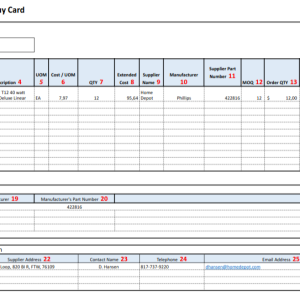
A Purchasing Record is a standardized document used to authorize and document purchases below a defined spend threshold where issuing a full purchase order would be inefficient. Internally, many organizations call this process a Buy Card, but clarity matters: a Buy Card is not a corporate credit card and not a workaround to procurement policy.
Instead, it is a structured spend authorization record that captures the minimum data required to support audit readiness and downstream reconciliation, including:
This creates a defensible procurement audit trail while still allowing speed for operational needs. You can see an example of Approval Limits in Purchasing by visiting the link below.
https://getyourpurchasingdocuments.com/product/approval-limits-template/
Why Purchasing Records Strengthen Procurement Controls
Low-value purchases are where procurement controls quietly erode. Individually, these transactions seem insignificant. Collectively, they create exposure through unauthorized spending, budget leakage, and reconciliation delays.
A Purchasing Record enforces discipline by ensuring every transaction—regardless of size—has documented approval, alignment with approval limits, and clear records of authorized purchases. Without this structure, organizations invite non-PO spending to accumulate outside visibility until an invoice forces the issue.
This is where many companies lose control without realizing it.
Purchasing Record Alignment with Internal Controls and Compliance
From an internal control’s perspective, undocumented purchases are a flashing warning light. A Purchasing Record creates a repeatable, consistent process that aligns procurement activity with financial controls and audit expectations.
Auditors are not chasing perfection; they are looking for consistency and traceability. A documented Buy Card process demonstrates:
This is especially important for organizations subject to SOX requirements, internal audits, or external financial reviews, where informal purchasing is often the first area challenged.
When to Use a Purchasing Record Instead of a Purchase Order
A Purchasing Record is intended for low-dollar, non-recurring, or time-sensitive purchases where issuing a purchase order would add friction without reducing risk. Typical use cases include maintenance items, operational supplies, emergency purchases, or one-time services.
It should never replace purchase requisitions or purchase orders for recurring, contractual, or high-risk spend. Instead, it functions as a controlled exception within the procure-to-pay process.
In some cases, such as ‘emergency purchases,’ company policy may still require after-the-fact purchase order issuance for system completeness. You can find an example of a Purchase Order Form by clicking on the link below.
https://getyourpurchasingdocuments.com/product/purchase-order-form/
How Purchasing Records Prevent Unauthorized and Non-PO Spend
Non-PO spend is not inherently dangerous. Undocumented non-PO spend is.
A Purchasing Record captures transactions that would otherwise surface only when an invoice arrives in accounts payable. By recording these purchases upfront, organizations gain visibility into buying patterns, enforce approval limits, reduce invoice disputes, and improve budget accuracy.
This is how informal spending becomes structured data instead of noise.
Purchasing Record Integration into the Procure-to-Pay Process
When properly implemented, the Purchasing Record is not a loophole—it is a formal step within the procure-to-pay workflow. It complements purchase requisitions for planned spend, purchase orders for sourced material, approval limits tables for governance, and receiving documentation for validation.
This alignment allows procurement to support operations without surrendering control, even when speed is required. You can find an article that discusses the Procure-to-Pay Process (P2P) at length by clicking on the link below.
https://getyourpurchasingdocuments.com/uncategorized/procure-to-pay-process/
Standardizing the Purchasing Record Template for Consistency
Standardization is where the real payoff happens. A uniform Purchasing Record template removes ambiguity, shortens training time, and ensures consistent application of internal purchasing controls across departments and locations.
Organizations that standardize this document experience fewer policy violations, faster approvals, cleaner audits, and better control of spending. The result is a procurement process that balances agility with accountability—and scales without chaos.
Monday – Friday: 9:00 AM – 5:00 PM CST
Other Dates and Times: By Appointment Only
469.500.3040
4705 Melrose Park Ct
Colleyville, Texas 76034
New Documents Coming Soon:
Site by DFW Website Designers
Sign up to stay informed on the latest news and exclusive offers from Get Your Docs.